Frequently Asked Questions About Traffic

The municipality regularly receives similar questions about certain traffic-related topics. These topics are listed below. For each topic, an explanation is provided for a number of frequently asked questions.

General

Can the municipality implement additional traffic measures?

Complaints and reports often request that measures be taken, such as installing speed bumps, bollards, or a traffic mirror. The municipality is reluctant to implement these types of measures. The guiding principles are traffic laws and road design guidelines. There are several reasons for this:

  • Measures often have adverse side effects, such as those affecting pedestrians or emergency services. Speed bumps can cause noise and vibration disturbances for nearby residents. Road narrowings can be dangerous for cyclists due to obstacles and the risk of getting stuck.
  • Measures often have just as many opponents as they do supporters.
  • Many measures are known to be ineffective.
  • Many complaints are based on experiences that are not sufficiently supported by facts and figures.
  • Distraction is a major cause of traffic accidents. An excessive number of traffic control measures—such as road signs—that a road user encounters can also cause distraction. As a result, a driver’s attention may wander away from what really matters, such as a pedestrian crossing the street.
  • The municipality has a limited budget that it must spend as effectively as possible, so preferably on measures that are useful or necessary for as many residents or road users as possible.

Can the municipality install an additional traffic sign?

The municipality is very reluctant to install additional traffic signs. A traffic situation should be sufficiently clear on its own, supplemented by the traffic signs required by law. This prevents an excess of traffic signs from developing. Too many traffic signs create a cluttered and confusing street scene. This could even have the opposite effect on traffic safety because it is distracting. 

Therefore, more traffic signs do not necessarily lead to improved traffic safety. The municipality’s goal is therefore to establish a clear system of traffic signs, with the right signs in the right places and without unnecessary signage. Here, too, traffic laws and road design guidelines serve as the guiding principles.

When can the municipality implement traffic measures?

The municipality keeps track of complaints and reports. When a street is scheduled for major maintenance, the municipality assesses whether improvements are possible and, if so, what those improvements might be. These could include improvements related to traffic—such as speed limits or parking—but could also involve public green spaces, for example. 

When space and/or budget are limited, the municipality strikes the best possible balance between the various wishes and needs. For larger projects, the municipality informs residents and stakeholders in a timely manner. The municipality considers meaningful participation to be important so that those involved can voice their opinions and share their ideas.

How are residents informed about traffic measures?

No letter will be sent to residents regarding minor traffic measures, such as the installation of a traffic sign. However, the municipality is required by law to issue a traffic resolution for various measures, such as the installation of traffic signs. Traffic resolutions are published and are available for public review for 6 weeks. You can find more information about traffic resolutions here.

Parking

Can the city do anything about the parking problem?

Many residential neighborhoods experience parking problems. For example, there may be too few parking spaces, cars may be parked in a way that causes a nuisance, or driveways may be blocked. When the number of cars looking to park exceeds the number of available spaces, this is referred to as high parking demand. Often, however, this parking demand turns out to be less severe than expected, and spaces are actually available—just a slightly longer walk away.

One reason for high parking demand is that many residential neighborhoods were not designed to accommodate the number of cars that exist today. Older neighborhoods, in particular, were built at a time when there were very few cars. Nearly all households now own a car, and many households have two or more cars. In addition, there are many homes where the carport or garage has been converted into extra living space or storage space. As a result, more cars have to park on the street than was intended when the neighborhood was designed.

Parking problems also arise because cars are being used more often for activities such as shopping or taking children to and from school or sports activities. The solution here lies more in reducing car use and less in building more parking spaces.

Another important point is that many public charging stations for electric cars need to be installed. To this end, parking spaces will be designated as charging stations, where not everyone will be allowed to park. This will reduce the number of regular parking spaces, thereby increasing parking pressure. The municipality is doing its best to balance the demand for charging stations with the need for parking spaces. You can find more information about electric driving and charging stations here.

In principle, the municipality does not create additional parking spaces. Nor does it, for example, install bollards or additional traffic signs, or impose a parking ban. When major maintenance is planned, the municipality assesses whether improvements are possible and, if so, what those improvements might be.

My exit is blocked—what should I do?

Parking in front of a driveway leading to a business or residence is not permitted—not even with your own car. You can report any issues to the Enforcement and Surveillance Department. You can also contact the Enforcement and Surveillance Department by calling the general phone number 14 071.

Electric Cars and Charging

How do I use public charging stations?

The Municipality of Voorschoten considers sustainability important and therefore encourages the use of electric vehicles (EVs). This also includes plug-in hybrids (PHEVs). Residents and business owners who do not have parking on their own property or a parking space provided by their homeowners’ association can apply for a public charging station. More information about electric driving and charging stations can be found here.

To use public charging stations, you must apply for a charging card. There are several types of charging cards available. To find out where you can apply for a charging card, visitLaadpaswijzer at. On this website, you’ll also find an overview of all the key features and up-to-date rates for the various charging cards.

What is the charging capacity of the charging stations in Voorschoten?

The municipality has regulated the provision and operation of charging stations through a concession. Charging stations from the first concession (2017–2021) have a capacity of 11 kW. Charging stations from the current concession (2021–2024) have a capacity of 22 kW. In principle, the old charging stations will not be replaced. The actual charging power also depends on the vehicle and the plug connection. It is possible that other providers will also install public charging stations, which may have a higher charging capacity. The municipality is also exploring the possibilities and developments regarding fast-charging stations.

What is the municipality doing to prevent charging stations from being occupied unnecessarily?

It is not permitted to occupy a charging station for an unnecessarily long time. According to the traffic regulations of the RVV (Article 24), a parking space must be used as indicated on any sign below it. The signs below the charging stations in Voorschoten read “charging electric vehicles,” so a car may only be parked there if it is actually being charged. 

Can I run a power cord across the sidewalk to charge my car?

No, this is not allowed.Althoughwe consider sustainability important and encourage initiatives, the municipality must also take other interests and practical considerations into account:

  • The municipality is responsible for ensuring that outdoor spaces are safe, easily accessible, and functional. Cables are a nuisance and can be dangerous for pedestrians with limited mobility and for children. Cables also pose an obstacle to items such as walkers, wheelchairs, and strollers.
  • Special mats do not adequately solve that problem; these are also uneven surfaces that can be bothersome.
  • When it comes to mats, there may be some debate over who is responsible: the owner of the mat or the municipality.

Recently, if your address meets certain conditions, you can request a cable trench from the municipality. A cable trench consists of special tiles with a built-in trench that are laid into the sidewalk. The cable trench ensures that no one can trip over the cable and that the cable is not damaged, as it is neatly concealed in the ground or within the special tiles. You can find more information about this and the application form on this page: Sustainable Transportation.

Speed

How does the municipality know how fast people are driving?

Complaints and reports regarding speeding are submitted regularly. The municipality uses a program that tracks various data, such as driving speed. This data covers the entire municipality and is derived from so-called “floating car data,” in which driving speed is calculated based on the standard signals emitted by vehicles and cell phones. This data is sufficiently comprehensive and reliable to make determinations regarding speed and to verify reports. In most cases, the measured speed differs only slightly from the speed limit, so there is no reason to take enforcement action or conduct checks. The municipality also conducts its own traffic counts and measurements.

To get an accurate picture of the speed at which vehicles are traveling, the so-calledV85 percentile is used. This is the speed that 85% of drivers do not exceed, while 15% of drivers do exceed it. This is done to filter out extremes from the measurement. There are always road users who drive (or want to drive) too fast despite the road layout. These road users do not provide a realistic picture of the actual traffic situation. TheV85 rule reflects the speed that a large majority of drivers perceive as reasonable and safe.

Does the municipality have electronic speed displays?

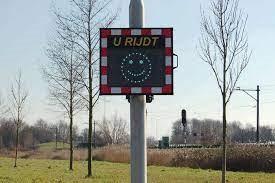
The municipality has a number of electronic speed displays. These are moved to a new location approximately every three to four weeks. This is part of the behavior-change campaign. Research shows that their impact begins to diminish after about two weeks. For this reason, we regularly move the speed displays to different locations. The displays show every passing driver how fast they are going, and this often has a positive effect on their behavior. The municipality determines the locations where the displays will be installed based, among other things, on reports from the public. The location must also meet a number of practical requirements, such as allowing the display to be mounted properly.

electronic speed displays

Electronic Speed Display

Can the municipality install speed bumps or other speed-reducing measures?

In principle, the municipality does not install additional speed bumps or other speed-reducing measures. During scheduled major maintenance, an assessment is made to determine whether—and, if so, what—improvements are possible.

Can the municipality conduct speed checks or install a speed camera?

The rules and conditions for speed checks are not determined by the municipality or the police, but by the Public Prosecution Service (OM). Road authorities, such as the municipality, as well as the police, have no influence over this. 

The police can therefore only conduct speed checks if permitted by the rules of the Public Prosecution Service. One of the Public Prosecution Service’s rules is that, in principle, speed checks are not conducted on 30 km/h roads or in 30 km/h zones. The speed cameras in the Netherlands—and therefore also in Voorschoten—are owned by the Public Prosecution Service, which also sets the policy regarding their use.

Can the municipality lower the speed limit?

The Municipality of Voorschoten follows national policy on road design. This policy also determines the applicable speed limit. Within built-up areas, the speed limit is 30 or 50 km/h, with the exception of “walking pace” in residential neighborhoods and 70 km/h on major thoroughfares. The latter does not apply in Voorschoten. 

In the Traffic Plan, the municipality has classified all its roads according to this principle, and this has also been used to determine the speed limits. With a few exceptions, this has also been implemented on the streets. In principle, speed limits other than those specified in the Traffic Plan are not permitted.

Questions and Contact 

If the explanation above does not fully answer your question, please send an email to verkeer@voorschoten.nl

If your inquiry concerns a specific location, please specify it by providing, for example, a street name and house number or a clear description. You may also attach a photo or map to your email. The municipality will contact you as soon as possible. Written inquiries will be answered within six weeks.