
The landscape park
A hot-air balloon ride, an escape room, or a trip to the cinema: we are constantly looking for variety, excitement, and entertainment. In the nineteenth century, it was no different. Prince Frederik of the Netherlands had a magnificent landscape park created on his country estates, offering endless experiences: a picturesque landscape, exceptional tree species, winding ponds, and surprising vistas. Proudly, he transported his guests through the park in a carriage, leaving them utterly spellbound at every turn.
Between 1838 and 1854, Prince Frederik purchased nine country estates in Wassenaar. This created one vast estate spanning no less than 886 hectares. It was his grand ambition to connect these estates and merge them into a single entity. Architect Hermann Wentzel primarily focused on the built elements, while landscape architects Johan David Zocher Jr. and Eduard Petzold were commissioned to enhance the natural beauty.
The English landscape style
Zocher and Petzold applied the English landscape style. This style gained popularity in the late 18th century. The elite had grown tired of French gardens, where everything was symmetrical and could be taken in at a single glance. Furthermore, maintaining a classic symmetrical garden was significantly more expensive than maintaining a landscape park. This shift in taste was partly inspired by artists who increasingly painted romantic, park-like landscapes. The elite wanted to experience this in reality! Nature was no longer to be tamed, but rather given space. Consequently, the English garden is filled with tree clusters and beautiful plantings. The design made maximum use of natural relief, and views of meadows and water were an integral part of the experience. Through this variety, there was always something new to see, resembling a living painting with exquisite color palettes and depth effects.
Splendid views
At De Horsten, you can enjoy a wonderful walk alongside an enormous pond. However, wherever you walk, the layout of the (peninsular) islands ensures that you can never see the entire pond at once. This was a deliberate trick by Petzold to make the pond appear larger and to create continuously shifting viewpoints. The overall effect was deeply impressive. A winding path that slowly ascended along a gentle slope led to an attractive bench. From there, Prince Frederik's guests had a magnificent view of the gatehouse, which peeked out from among the trees and naturally looked immaculate. Curious? This stunning view still exists today!
Lines of sight
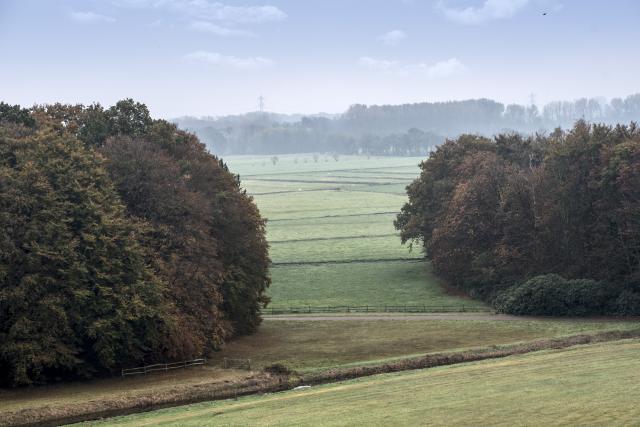
Zocher Jr. and Petzold also incorporated many intriguing lines of sight. Achieving this sometimes required felling quite a few trees. This is clearly visible when looking southeast from the Seringenberg. A strip of forest is interrupted there, providing a magnificent view toward Ter Horst hunting lodge. The winding path between Raaphorst and Ter Horst also features such a line of sight. This path suddenly makes a turn of nearly 90 degrees, abruptly presenting Prince Frederik's guests with a view of the idyllic village of Voorschoten. Through these surprises, the prince left a deep impression on his guests.
Appearances can be deceiving
Prince Frederik’s parks were meant to give the impression that nature was left entirely to its own devices. But nothing could be further from the truth. The park required a great deal of maintenance, and at times the prince employed as many as 200 workers at once. For example, they dredged 35, kilometre s of ditches each year to ensure that the water could continue to flow freely. The gardeners also kept sightlines open by pruning trees and shrubs. And they meticulously maintained the paths so that the elite could enjoy the park without getting branches in their faces or sinking ankle-deep into nettles.
The gardens of Ter Horst
Prince Frederik had his parks adapted to the English landscape style. Ter Horst is the sole exception. Since the last quarter of the 17th century, a geometric French garden has been situated here, and it remained unchanged when the prince purchased this estate. Ter Horst is located on a narrow sandy ridge, and everything surrounding it was simply too wet to construct an English garden. This results in a unique piece of history, as this combination of a French and an English garden cannot be found anywhere else in the Netherlands. If you look past the boxwood hedge along the straight path through the Voorschoten section, you can still find the formal 17th-century avenue structures.
Access to the landscape
Prince Frederik not only let his guests enjoy the scenery; he also allowed the common people to walk there when he was away. This is characteristic of the prince’s kind nature, because he wasn’t obligated to do so. Visitors could purchase a ticket in writing from his steward or court marshal. So not much has changed, because even today you need an admission ticket. You can order the “ Maps ” online,
Discover it for yourself!
Has these stories made you curious about Prince Frederik's magnificent landscape park? Then be sure to head out and explore! Enjoy the stunning purple splendor of the Seringenberg, the ponds, and the winding paths. Climb the various hills for a breathtaking view and let yourself be surprised by all the beauty that De Horsten has to offer.