
The carriages of Prince Frederik
These days, just about everyone owns one or more cars. We hop on a train, a bus, or a aeroplane without giving it a second thought. We consider it normal to head out the door and travel long distances. But in Prince Frederik’s day, this was anything but a given. In fact, ordinary people did everything on foot and never went anywhere. Taking long trips and pleasure rides in a carriage was a luxury reserved only for the wealthy.
In the 19th century, owning a carriage required a substantial wallet: a carriage was usually pulled by two horses, the coachman sat on the box, and a groom often stood at the back. Carriages had to be maintained, horses needed shelter and food, and staff had to be paid. Furthermore, there were often multiple carriages; Prince Frederik possibly had between 15 and 25. Historians deduce this from the massive coach house that belonged to De Paauw, which had space for 15 carriages.
A different carriage for every purpose
Each carriage had its own function. Luggage was transported in a baggage cart, and the staff travelled in a large omnibus, a long coach that could hold everyone. Ladies often got into a Victoria for a pleasure ride: a semi-open carriage with a low step so they wouldn't trip over their long gowns. And wealthy men went hunting in sporty carriages or showed off their driving skills in a Phaeton: a light, open sports carriage where they sat on the box themselves. A coach was closed and therefore ideally suited for longer journeys.
Carriages subject to fashion
Did you know that you can tell the era of a carriage by its construction? New technical developments continuously improved comfort. Moreover, the appearance of a carriage was subject to fashion. Therefore, carriages were regularly replaced by a more modern model, even if the older vehicles were still quite usable. Prince Frederik also regularly allowed himself to be tempted to purchase a new carriage. The elite of back then was not all that different from today's car enthusiasts!
Wanderlust
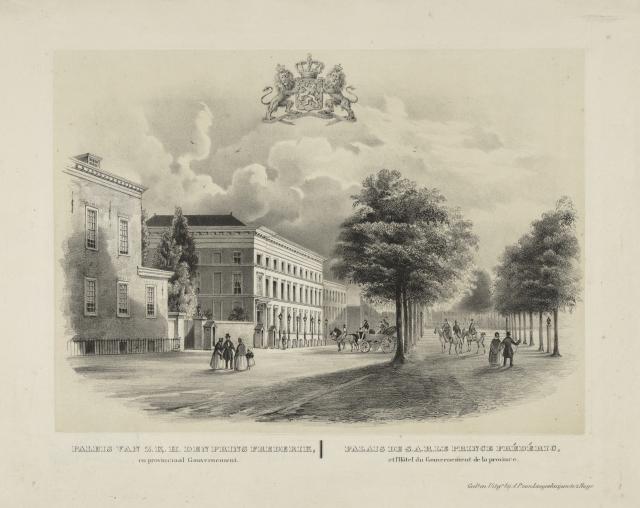
The lives of the aristocracy revolved around visiting one another. It was a way to conduct business, maintain social ties, and arrange marriages. Travel was also a way to escape the heat of the city. Prince Frederik, too, was an avid traveler. He traveled with ease from his city palace in The Hague to his estates in Wassenaar and Bad Muskau, a town on the Oder River in what is now the German-Polish border region. Although roads improved steadily throughout the nineteenth century, travel was slow. A carriage could cover about ten to twelve kilometre s per hour.
Little spontaneity
Do you ever decide to head out spontaneously? In Prince Frederik's time, that was unthinkable. Every journey, no matter how short, involved massive preparation: stable hands polished the carriage, brushed the horses and harnessed them. Servants packed the belongings, and the coachman and footmen donned their impeccable uniforms. Journeys abroad were also prepared step by step by Prince Frederik's secretary or lord chamberlain (head of the household). Setting off was therefore a time-consuming activity that was always announced well in advance.
Pleasure trips to impress
Prince Frederik had had a magnificent landscape park laid out on his estates in Wassenaar. During a pleasure ride, he loved to impress his guests with everything the park had to offer: stunning views, large meandering ponds, exciting vistas and much more. Paths were constructed especially for the carriages, allowing his guests to experience the park in a magnificent way while riding. Would you also like to feel like a nobleman or noblewoman for a moment? Then walk or cycle (parts of) the Park Route and experience the beauty just as they did in the nineteenth century!
Hitting the road by train
On May 1, 1843, a train station opened in Voorschoten. It was an extension of the Amsterdam–Haarlem–Leiden–The Hague railway line. From then on, Prince Frederik used the train regularly to pay visits. It also allowed him to reach his family in Berlin or his estate in Bad Muskau much more quickly. Of course, he didn’t ride in a compartment with other travellers. It may be hard to imagine today, but he had his own railcar that was coupled to the train. Now that was traveling in luxury and style! The railcar that Frederik regularly used had been built for Queen Anna Paulowna, wife of William II, but she died before she could use it. You can admire this car (a miniature palace on wheels) at the Railway Museum in Utrecht.