
Well prepared
The world is changing, and with that come new risks. What once seemed unthinkable can now really happen. That’s why it’s important to be well prepared. Even in Voorschoten, you could find yourself in an emergency situation.
The municipality works together with emergency services to protect your safety. But sometimes a situation is so severe that help may not arrive immediately. This page is here to help you stay resilient and resourceful in challenging times.
Take action yourself
On this page, you’ll find three key actions you can take: put together an emergency kit, make an emergency plan, and talk about it with your family, friends and neighbours. Many people have already done this. Will you join them?
Putting together an emergency kit
Having an emergency kit means you’ll be better prepared when something goes wrong. More and more people are putting a kit together. You can do the same, so you’ll have the most essential items at home. If necessary, you should be able to manage on your own for at least 72 hours.
Check the image to see what you need. Store everything in a fixed, easily accessible place. Use a waterproof bag, such as a rucksack. That way, you can take it with you quickly if you need to leave in a hurry.
Consider your own situation
Check your emergency kit every six months to make sure it’s still complete. Make sure items haven’t expired. Also consider your personal needs. Do you require extra items, such as medicines or baby food?
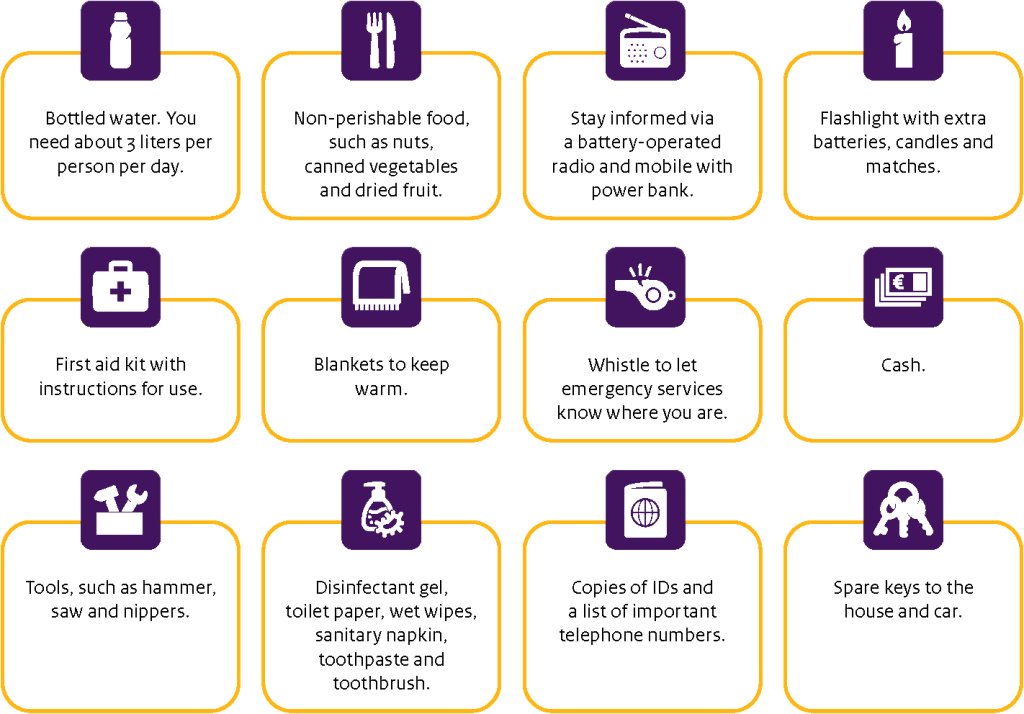
Infographic written out as text
The infographic displays 12 symbols. Below each symbol is a short explanation:
- Bottled water. You need about 3 litres per person per day.
- Non-perishable food, such as nuts, canned vegetables and dried fruit.
- Stay informed via a battery-operated radio and mobile with power bank.
- Flashlight with extra batteries, candles and matches.
- First aid kit with instructions for use.
- Blankets to keep warm.
- Whistle to let emergency services know where you are.
- Cash.
- Tools, such as hammer, saw and nippers.
- Disinfectant gel, toilet paper, wet wipes, sanitary napkin, toothpaste and toothbrush.
- Copies of IDs and a list of important telephone numbers.
- Spare keys to the house and car.
Making an emergency plan
Every emergency is different. A plan helps you know what to do and how to support your family, friends and neighbours. You’ll find important tips on this page. If you also answer the questions under “Talking about it with your family, friends and neighbours”, you’ll be even better prepared.
Tip 1: Follow instructions
If you receive an " NL" alert on your phone, read it immediately, follow the instructions, and help others. If the air-raid siren sounds on a day other than the first Monday of the month, go indoors right away, close windows and doors, and follow the news on the radio, TV, or the internet.
Tip 2: Listen to Radio West
During a power outage, TV and internet may not work. A battery-powered radio is very useful. Tune in to Radio West (89.3 FM) for official government updates. This station continues broadcasting even in an emergency.
Tip 3: Stay calm
Whatever happens, stay calm. Stay at home as much as possible and avoid travelling by car. Inform and assist your neighbours. Call 112 if you are injured or in immediate danger. If you’re safe, see if you can help others.
Talking about it with your family, friends and neighbours
Do your family, friends and neighbours know what to do in an emergency? Are they paying attention to the news on radio or TV? Do they also have an emergency kit? Talk to one another. Being well prepared gives peace of mind.
Discuss these questions together:
- Who do I call in an emergency?
- What do I do if I can’t reach my family members?
- Where do I go in an emergency?
- What arrangements do I have with childcare and school?
- Who picks up the children?
- How do I turn off the electricity if needed?
- How do I shut off the water if needed?
- How do I shut off the gas if needed?
- How do I stay warm?
- How do I boil water without electricity or gas?
- Where is the nearest defibrillator (AED)?
- Who needs medical aids or medication?
- How do I get light without electricity?
- Who will be our household emergency contact?
- Which neighbours have health vulnerabilities?
Want to learn more?
Useful websites
Important phone numbers
- Emergency services (police, fire brigade, ambulance): 112
- Police (non-emergency): 0900-8844