
Frequently Asked Questions About WarmtelinQ
What is WarmtelinQ?
WarmtelinQ is the pipeline that brings residual heat from the port of Rotterdam to our region. Residual heat is heat released during an industrial process that can no longer be used for anything else there. The WarmtelinQ pipelines are already being installed towards some of our neighbouring municipalities. To heat homes, additional pipelines are required within the municipality that connect to WarmtelinQ.
What is a communal heat system or heat network?
A shared heating system, also known as a district heating network, is a solution that serves multiple homes and buildings at the same time. It can be used to heat an entire street, neighbourhood , or neighborhood. In a district heating network, hot water flows from a source (such as waste heat from the Port of Rotterdam) through underground pipes to all connected homes.
What is the ultimate goal for the energy transition?
In line with the national Climate Agreement, the Municipality of Voorschoten aims to heat all homes and buildings completely free of natural gas by 2050.
Will a heat network, if a connection becomes available, be intended for all of Voorschoten in principle?
Approximately 80 percent of the homes in Voorschoten are suitable for a heat network. An important factor in making that choice is the cost. Other homes, for example, are better suited for a heat pump because that is more affordable for those properties, such as when a home is exceptionally well insulated.
What determines whether or not your home will be connected to WarmtelinQ or a heat network?
That depends on whether a heat network is being installed in your street, and whether you want to connect yourself—if you own your home—or if your landlord wishes to do so. If you belong to an Association of Owners (VvE), you must decide together whether to participate in a heat network.
Are all homes suitable for a heat network?
Usually yes. However, we look at what the most cost-effective solution is. If houses are located far apart, a heat network may be less suitable, or if a home is exceptionally well insulated, for example. It also depends on the temperature of the heat supplied by the network. The temperature of the heat from WarmtelinQ ranges between 55 and 75 degrees Celsius. There are also heat networks with lower water temperatures, which are suitable for extremely well-insulated homes.
Do I need to remodel my home for a heat network to function properly?
No. There only needs to be space for the heat network delivery station. In effect, the delivery station acts as the central heating boiler for the heat network user. It serves as the link between the heat network and the radiators and hot water taps in the home.
What happens when the industrial waste heat from Rotterdam runs out?
The waste heat will not run out. What you might mean is that companies in Rotterdam must become more sustainable. However, even after they have made their operations more sustainable, they will still generate waste heat.
How sustainable is the waste heat from Rotterdam? And what are the consequences for Voorschoten if companies in Rotterdam become sustainable? Will there still be waste heat available?
Residual heat is generated by industrial processes that are not yet sustainable. If this heat is not utilized in a heat network, it is discarded unused into surface water and/or the air. The heat is CO₂-free because it has already been used in industrial processes and would otherwise be discarded unused. The Climate Agreement and the EU “programme ” “Fit for 55” stipulate that industry must also significantly reduce CO₂ emissions and become more sustainable by 2030, and achieve CO₂ neutrality by 2050. However, even sustainable production processes release heat that can be utilized in district heating networks. The industry (Rotterdam-Moerdijk Energy Strategy Cluster) has indicated that it expects to have even more residual heat available in 2050 than it does today.
How is heat loss prevented between Rotterdam and Voorschoten?
There will be some heat loss between Rotterdam and Voorschoten, but this has been taken into account. The temperature of the hot water remains sufficiently high.
How can we organize this (a connection to a heat network, ed.) for the group of Owners Associations (VvEs)?
If a heat network is being introduced in your area, you and the other members of your Owners' Association (VvE) can explore the possibilities. However, it is essential that a sufficient number of people are willing to connect. You can request advice from the municipality or the energy desk, and they will refer you accordingly. For a heat network, Owners' Associations represent a specific target group that also receives special attention from the municipality.
If we participate, can we still choose our own supplier or arrange something else ourselves?
If by “arranging something else” you mean that you can choose a different heating method, and you’re a homeowner, then that’s Sun. . You cannot choose your own heat supplier. That’s handled by a heating company, and they provide service to all of Voorschoten.
When can we use the heat from WarmtelinQ in Voorschoten: in zero to five years, or five to 10 years?
Heat from WarmtelinQ is not expected to be available in Voorschoten before 2030. For each cluster of compatible homes, the municipality, in collaboration with residents, housing associations, social organisations, and other partners, will draw up a heat plan. This plan will outline the best sustainable heating solution for those homes and how we will approach this together.
Is connecting to a heat network mandatory? Do we, as residents, have a choice?
Connecting to a heat network is not mandatory. You retain the freedom to choose an alternative heating solution.
If you have chosen WarmtelinQ and it proves disappointing, can you switch back to another solution within a year?
No, that is not possible.
What is a heat exchange station and where are the potential locations for it?
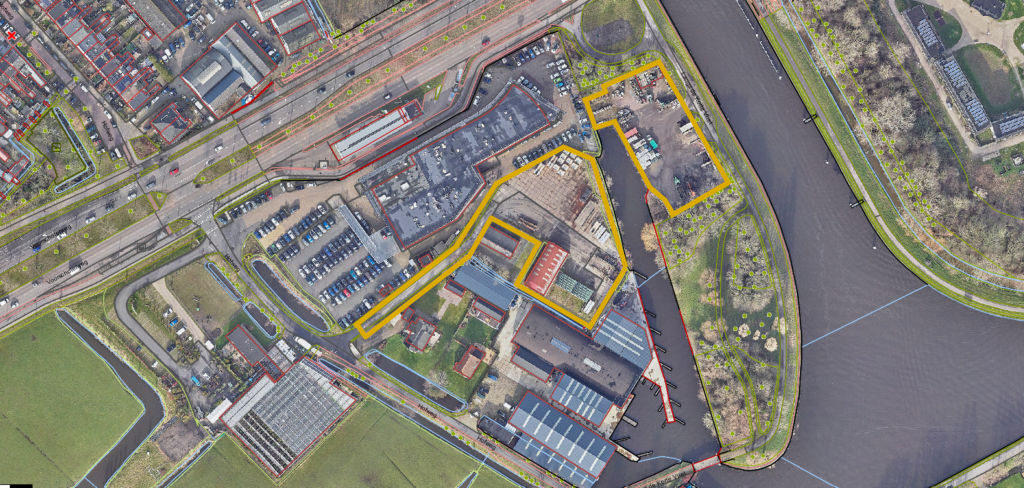
Voorschoten has reserved two locations (see yellow outline in the image) in the Hofweg “ neighbourhood .” A heat transfer station, as the name suggests, is needed to transfer heat from the WarmtelinQ pipeline to the local pipelines that may be installed in Voorschoten. It will also house a system that provides supplemental heating when it’s cold or in case of emergencies.
The questions and answers above are continuously updated. Do you have another question about heat networks and/or WarmtelinQ? Please send an email to duurzaam@voorschoten.NL.