
Train accident
On Tuesday, April 4, 2023, around 3:30 a.m., a train accident occurs at the Voorschoten station. A construction crane, a freight train, and a passenger train are involved. The BAM construction crane operator is killed. There are approximately 50 travellers on the passenger train, 30 of whom are injured.
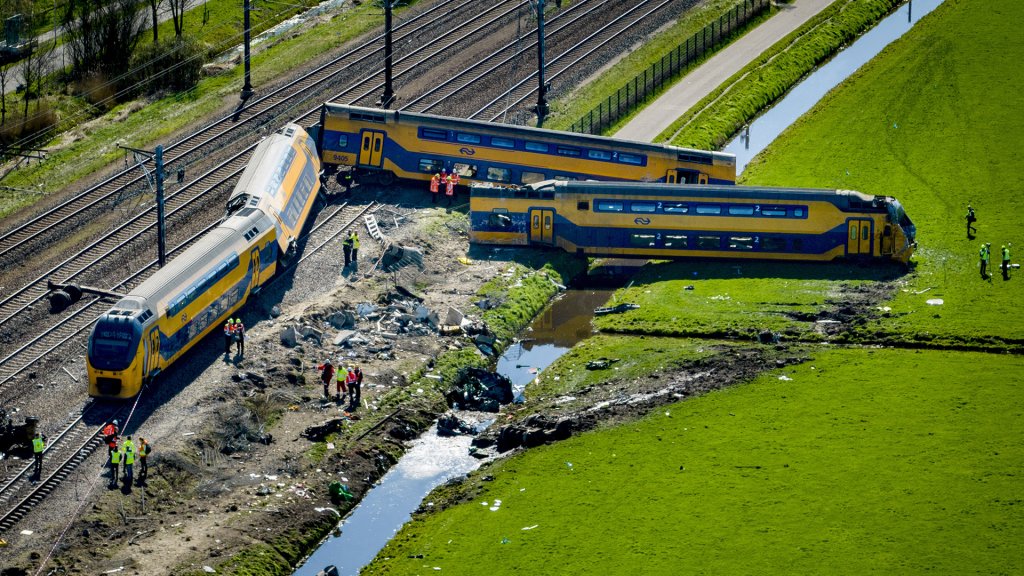
The crashed passenger train, viewed from the air. Photo: ANP / Robin Utrecht.
The accident has left a deep impression on everyone involved, from the victims and their loved ones to local residents, emergency services from across the region, government organizations, the King, and municipal employees. For days, Voorschoten was in the news, even reaching CNN. However, there is still a great deal of work to be done in the weeks that follow. A brief look back.
What exactly happened
Tuesday morning, 03:25. Residents near Voorschoten station are woken by a loud bang. Two minutes later, an even louder second bang follows. The cause is a train collision involving a construction crane, a freight train, and a passenger train. It is only in the course of the day that the exact sequence of events becomes clear.
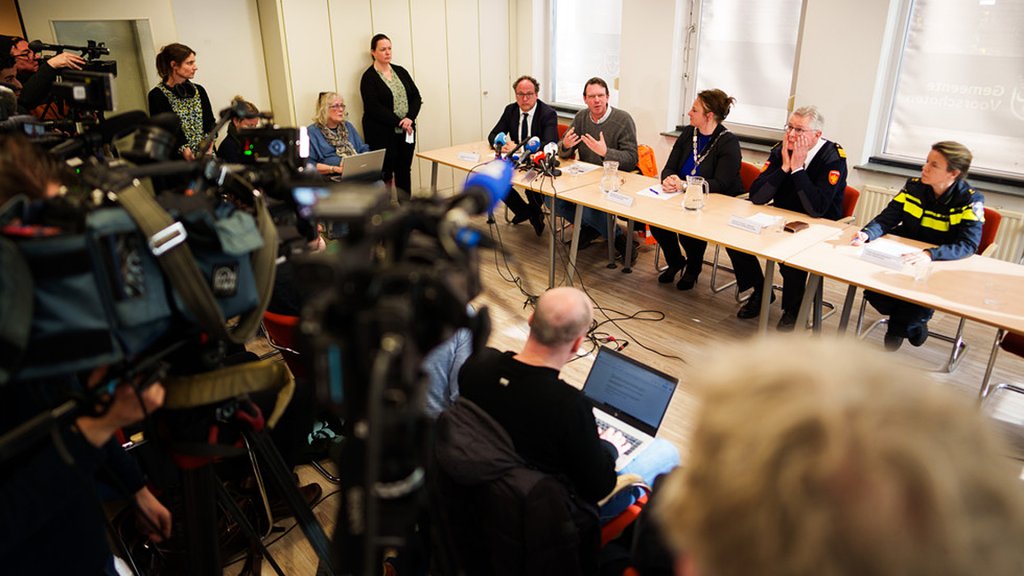
Press conference at the “ town hall.” From left to right: Wouter Koolmees (NS Director), John Voppen (ProRail CEO), Nadine Stemerdink (Mayor of Voorschoten), Hans Zuidijk (Director of the Hollands Midden Safety Region), and Marieke van den Bosch (Leiden Bollenstreek Police). Photo: Freek van den Bergh.
The first impact occurs when a freight train heading towards The Hague collides with a crane on rail lorries (krol) crossing the tracks. This happens just past Voorschoten station, near the Geestwoningpad. The construction crane and debris end up on the tracks. The second impact follows when an Intercity train traveling from Leiden Central towards Rotterdam hits the debris and derails. A fire breaks out on the train, and two of the four carriages end up in the meadow.
Bad dream?
The severity slowly sets in. After the initial shock, local residents wake up and look at each other. One suspects a train has derailed, while another thinks a freight train has lost some cargo. But with the second impact, the houses shake to their very foundations. Emergency dispatcher Wendy is just about to ask the very first 112 caller if they might have had a bad dream, when she hears that same impact over the phone and realizes she must immediately scale up the response.
50 travellers, 30 injured
There are approximately 50 travellers on the passenger train. Some of them manage to find their way out on their own. After ProRail cuts the power to the overhead lines, the rest of the travellers are also evacuated from the train. Thirty of them are injured; 19 must be taken to the hospital, including the NS train operator. Emergency responders and local residents take care of the rest travellers. The De Boschbloem community center opens its doors to offer a cup of coffee and a listening ear.
Crane operator Martin
What is inside that freight train? That is one of the first questions emergency services ask during such an accident. No hazardous materials are allowed to be transported on the railway near Voorschoten. Indeed, it involves harmless unslaked lime. Regardless, the train accident leaves a deep impression on everyone involved. In our thoughts, we are with Martin, the 65-year-old construction crane operator from Limburg who lost his life, his surviving relatives, and the injured.
Earlier accident in 1926
It is not the first time Voorschoten has faced a train accident. Near De Vink station on September 9, 1926, an express train from Rotterdam to Amsterdam derailed. The steam locomotive with tender and postal carriage overturned, the baggage car ended up transversal across the tracks, the first passenger carriage ended up in the ditch, and the second was heavily damaged. Four people lost their lives. Ten people were seriously injured.
Emergency services in action
The numerous phone calls from both local residents and passengers calling the emergency number quickly make it clear that this is an accident with a major impact. Around 03:37, the first emergency services arrive and the response is scaled up very quickly.
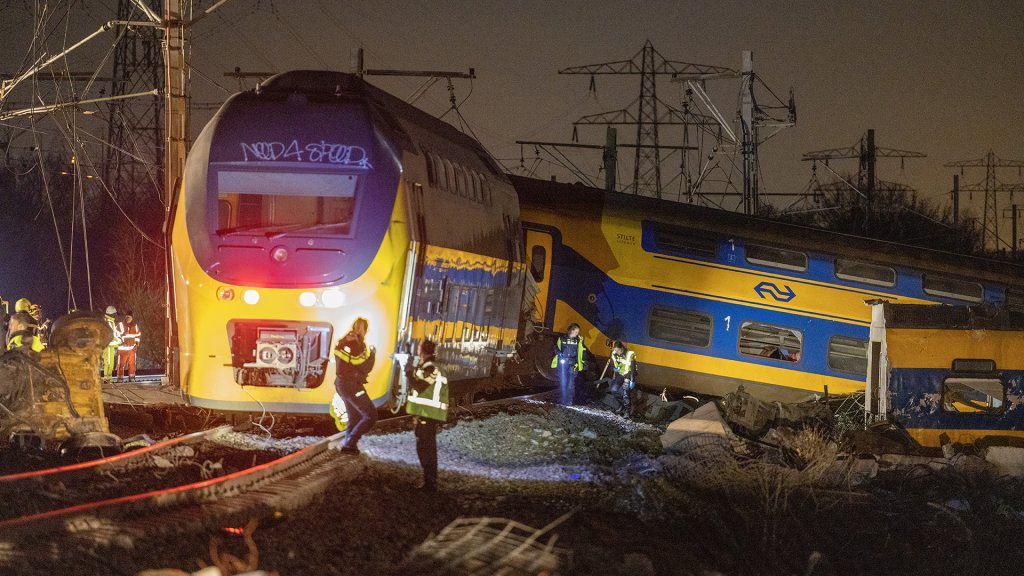
Emergency workers in the dark. Photo: ANP / Michel van Bergen.
"Providing assistance was not easy. 'It was dark, the overhead wire was broken, cries for help could be heard, fire was visible, and a ditch had to be crossed to reach the train,' summarizes Hans Zuidijk, director of the Hollands Midden Safety Region, describing the scenario."
More than 200 emergency workers
Voorschoten Fire Department is the first on the scene, followed by a police car from Leiden-Zuid and an initial additional deployment from the safety region. Ultimately, more than 200 emergency workers from the police, fire department, and ambulance services from various regions hurry to Voorschoten, reaching as far as Leerdam in the far corner of the Zuid-Holland Zuid region.
Flawless approach
Despite the chaos, the initial emergency response goes smoothly. An upside-down picnic table serves as a makeshift bridge over the ditch. Within two hours, the seriously injured have been transported to five hospitals, and the remaining passengers travellers continue their journey from The Hague Central Station after being transported by an NS bus. Meanwhile, Victim Support Netherlands launches a website offering information and advice.
Farmer Freek and the general practitioner
The hospitable local residents are putting Voorschoten in a positive light in the news. Farmer Freek takes in stranded travellers in his barn. With chairs they’ve dragged over and some tea, they recover from the shock. The family doctor—who, as it turns out later, is a geriatric specialist—helps the injured by giving them stitches and a sling. Still others make coffee or lend out their phone chargers.
Help from Italy
Support even comes from Italy. Deputy Prime Minister and Minister of Infrastructure and Transport Matteo Salvini expresses deep solidarity with those involved, all Dutch residents, and the government of the Netherlands. “L’Italia è pronta a fornire supporto”, the Italian news agency ANSA quotes the minister.
Ribbon from Peter Heerschop
The news does not escape comedian, actor, and columnist Peter Heerschop either. On NPO Radio 1, he even hands out a ribbon: “The award in the Order of the Open Door and Come Right In goes to the municipality of Voorschoten.”
Visit from the King
Around 12:00, King Willem-Alexander arrives at Brunita J. Gemmekelaan, where residents overlooking the railway line provided assistance that night and opened their homes. State Secretary for Infrastructure and Water Management Vivianne Heijnen joins with a NOS camera crew.
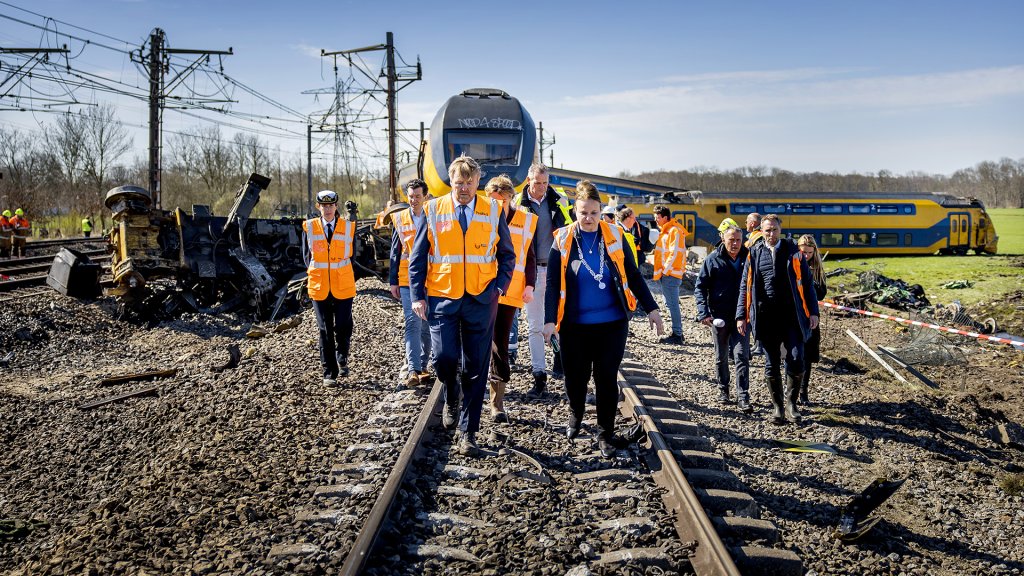
The King and the mayor inspect the tracks. Photo: ANP / Robin van Lonkhuijsen.
After a brief briefing at the command post, a walk along the train carriages is planned. The King is impressed by what he hears about the rescue efforts. “I am incredibly glad to see how quickly the emergency workers arrived here and what fantastic work they have done.”
Speechless
The King is speechless about the forces that were unleashed. “When you see what kind of weight. What a mass and speed. That is simple physics. But when you see it lying there, it truly leaves you speechless.”
Salvage and restoration
On Wednesday, April 12, the passenger train will begin to be removed. Once the train cars have been removed, the damage can be repaired. Until then, buses will run between The Hague Laan van NOI and Leiden Centraal. On April 20, travellers will be able to ride the train again.
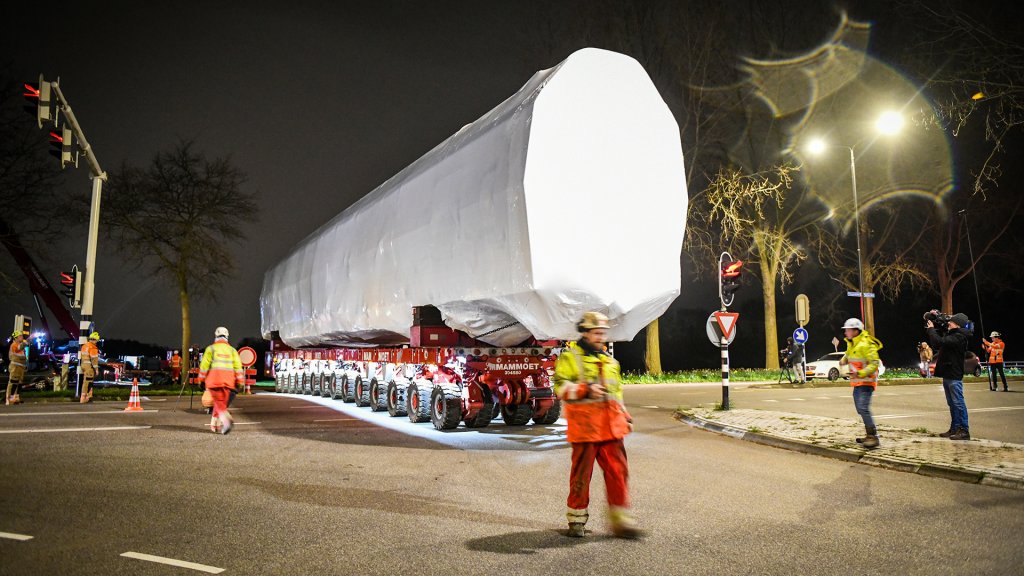
An SPMT crosses Papelaan-West. Photo: ANP / Josh Walet.
Once the freight train and the construction crane have been towed away from the tracks, a massive task lies ahead: recovering the passenger train. The streets of Voorschoten and the viaduct are simply not designed to handle the heavy equipment required for the operation. The municipality is therefore grateful to the Van Vliet family for allowing the recovery to take place safely from the pasture.
Working day and night
However, challenges remain. For instance, a temporary road must be constructed across the marshy meadow, the ditch must be filled in, culverts are needed to protect the water pipes, and storage areas must be established where cranes can hoist the train sets onto low-loader trucks. Work continues day and night, including throughout the Easter holidays.
SPMT
To begin with, a heavy crane from Mammoet places the two crosswise train sets neatly into the meadow. To prevent oil and glass shards from ending up on the land, the train sets are shrink-wrapped. That same night, they are loaded onto a Self Propelled Modular Transporter (SPMT) and driven to Nippon Express.
Two train sets via the tracks, two via the road
At the Nippon Express industrial site, the train sets are tilted so they can fit under viaducts. On Thursday evening, they depart on low-loader trucks to an NS maintenance facility. The third train set is lifted and fitted with a new bogie. Subsequently, it is transported away via the tracks along with the fourth train set behind a diesel locomotive.
Night we will never forget
The damage is extensive, including in the area around the station. At the Van Vliet farm, part of the topsoil will need to be replaced. And the municipality will have to, for example, replant shrubs and restore traffic control systems. There is no longer any sign of the damage, but April 4, 2023, remains a night that travellers, residents, and first responders will never forget.