
The Holland Rijnland Region Adopts an Investment Agenda Featuring Fourteen Major Projects
The General Board of Holland Rijnland has approved a Regional Investment Agenda. It outlines fourteen major projects that the municipalities of Holland Rijnland (including Voorschoten) will carry out jointly, such as a framework of nature and recreation projects, an “energy lane” for heat and electricity, a high-quality public transportation corridor, and a network of through-cycle paths.
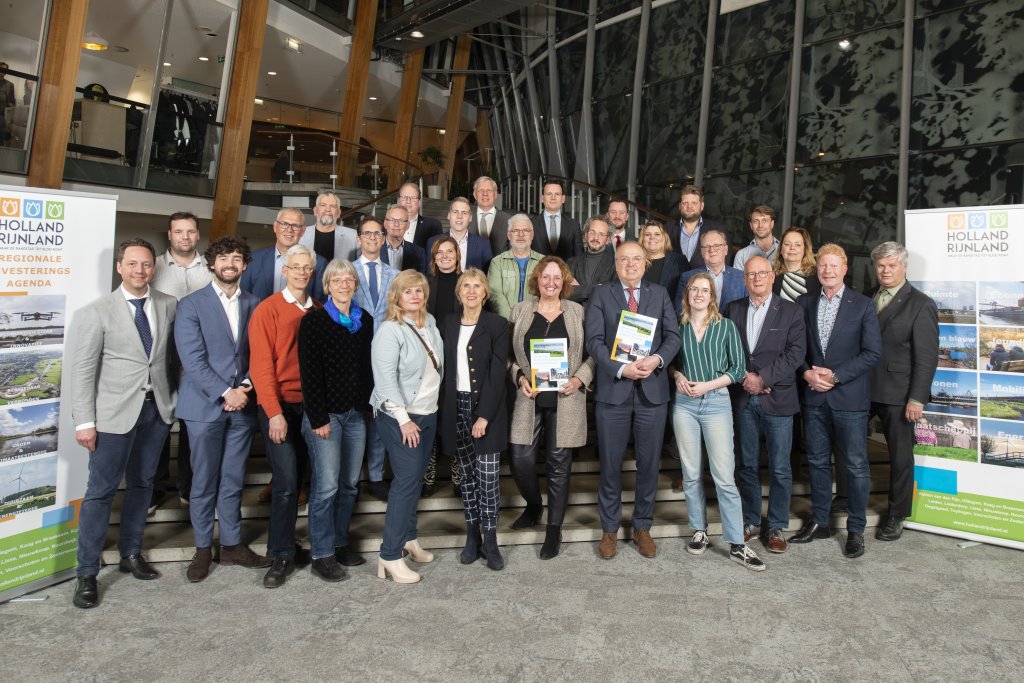
Through the Regional Investment Agenda, Holland Rijnland is making decisions in the areas of housing, the economy, nature, climate, accessibility, and sustainability. “Our ambitions are grand,” says Liesbeth Spies, mayor of Alphen aan den Rijn and member of the Executive Board of Holland Rijnland. “Between now and 2050, we’re preparing our living environment for the future. This investment agenda will lead to projects worth tens or hundreds of millions of euros. This will ensure greater overall well-being for our residents.”
The mayor of Leiden, Peter van der Velden, is the chair of Holland Rijnland. He explains why the municipalities have jointly adopted the Regional Investment Agenda: “We face diverse and challenging tasks. These tasks extend beyond municipal boundaries and are too large for any single municipality to tackle on its own.”
Investment of €7 million
For the Regional Investment Agenda, the municipalities are making a one-time contribution of €7 million for the period from 2025 to 2027. Of that amount, €4 million will go toward research to develop the projects, and €3 million will go to a regional fund for smaller-scale projects. This does not yet cover the costs of the major projects in the Investment Agenda: the municipalities will use the research funds to advance the projects in the Regional Investment Agenda. The goal is to secure external funding from the province(s), the national government, and the European Union.
Business Community Backs Investment Agenda
The business community in the region supports the Regional Investment Agenda for Holland Rijnland and the specific projects it contains. Martijn van Pelt, chair of VNO-NCW Rijnland: “Regional cooperation among municipalities in the economic sphere is absolutely essential. It is encouraging that our initiative to establish a Regional (Re)Development Corporation for Industrial Parks has been adopted. In addition, we believe it is important to strengthen the economic clusters and business activity along the urban corridor stretching from Noordwijk, through Katwijk and Leiden, to “ Alphen ” on the Rhine. The opening of the RijnlandRoute marked an important step in this direction, but high-quality public transportation along this corridor must also be urgently improved if our region is to both grow and remain accessible.”
The Dune and Bulb Region Wants Improved Accessibility and a Better Energy Supply
Jolanda Langeveld is a member of the Executive Board of Holland Rijnland and a member of the Municipal Council ( Alderman ) in the municipality of Lisse. She explains why the Duin- en Bollenstreek region is embracing the Regional Investment Agenda: “Our ambition is to preserve the region’s strengths while simultaneously addressing the challenges we face. We are strengthening the landscape, the economy, and quality of life in synergy with one another.”
“It is extremely important that our accessibility is up to par,” says Langeveld. “This applies to both visitors from outside the area and our own residents. We want to promote proximity between where people live and work and encourage the exchange of knowledge. A second prerequisite is a reliable and sustainable energy infrastructure. This is necessary to develop the economy, quality of life, and sustainability in a coordinated manner.”
The Green Heart Wants to Remain Economically Viable and Livable
Robbert-Jan van Duijn is a member of the Executive Board of Holland Rijnland and Mayor of Nieuwkoop. He explains why the Green Heart municipalities in Holland Rijnland support the Regional Investment Agenda: “Kaag en Braassem, Nieuwkoop, Alphen aan den Rijn, Leiderdorp, Zoeterwoude, and Teylingen together make up a significant portion of the Green Heart. They offer beautiful nature and landscapes and are undergoing rapid development. The Green Heart faces major challenges related to agriculture and horticulture, nature conservation, energy, land subsidence, and water management. This presents opportunities for nature and recreation—and, consequently, for quality of life and (broad) prosperity throughout the Randstad.”
“The Green Heart isn’t just the ‘garden’ of the Randstad,” says Van Duijn. “Above all, it’s the living environment of our own residents. We want to keep the area economically vibrant and livable for them, with good amenities, reliable energy, and accessible villages. In other words, a reciprocal relationship between urban and rural development.”
Connecting the Urban Axis for Innovation and Employment
Gerard Mostert is a member of the Executive Board of Holland Rijnland and of “ Alderman ” in Katwijk. “The Urban Axis is a contiguous urban area stretching from Katwijk through Leiden to Alphen on the Rhine. This area is evolving into a single, cohesive system in which the (circular) economic activity of Alphen on the Rhine complements the knowledge clusters around Leiden, Katwijk, and Noordwijk. By retaining or attracting the right businesses to the right locations and fostering collaboration among them, we strengthen the region’s innovative character and regional employment. To achieve this, effective regional networks for energy and mobility are essential.’
“There’s a lot to be done along this Urban Axis,” said Mostert: “We’re working on the scale upgrade of the Leiden Centraal Interchange and are fully committed to the energy transition. We’re protecting and enhancing our beautiful landscapes, connecting the city with its surrounding countryside, and making the city greener. The decision to increase density along the Urban Axis makes it possible to preserve our beautiful, diverse landscapes and prepare them for the future.”
About Holland Rijnland
The Holland Rijnland region consists of the municipalities of Alphen -aan-den-Rijn, Hillegom, Kaag en Braassem, Katwijk, Leiden, Leiderdorp, Lisse, Nieuwkoop, Noordwijk, Oegstgeest, Teylingen, Voorschoten, and Zoeterwoude. Together, we form the Holland Rijnland region and are committed to addressing the regional challenges facing these thirteen municipalities in the heart of the Randstad. We work together to improve housing, employment, and well-being for our residents. We face a wide range of challenging issues in the areas of housing, the economy, nature, climate, accessibility, and sustainable energy.