
National Remembrance Day, May 4, 2026
Mayor Nadine Stemerdink, together with children from the VOS public elementary school, laid a wreath this evening at the monument on Koningin Julianalaan in Voorschoten.
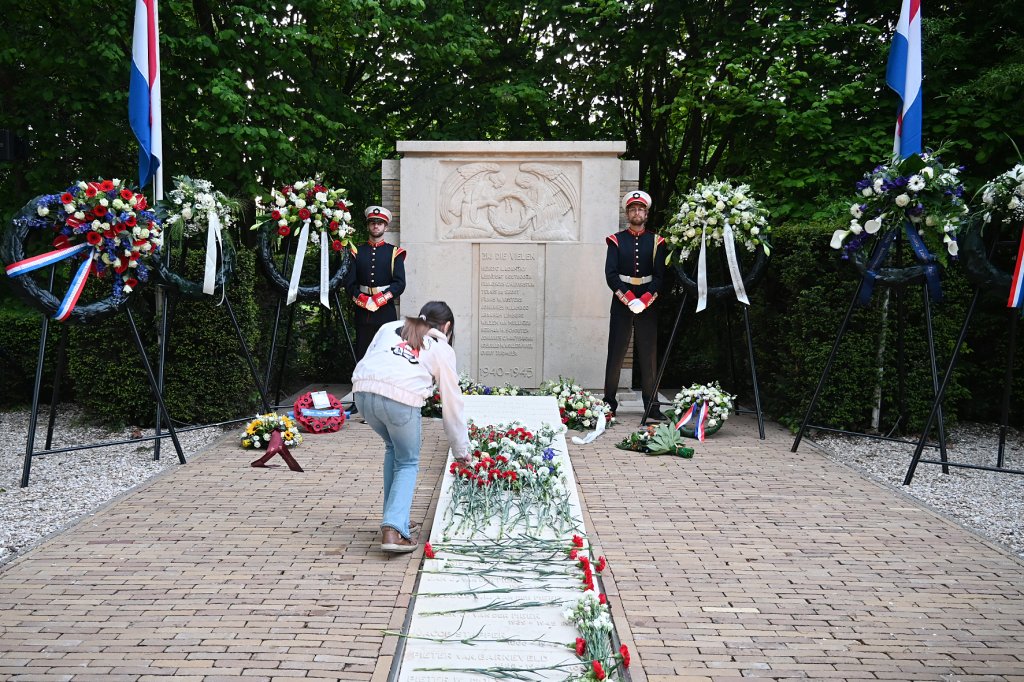
Students read poems they had written themselves. Other guests also laid wreaths. They were assisted by Scouts from the Kimball O’Hara and Maurits groups. Veterans formed a guard of honor next to the monument throughout the commemoration. The Laurentius Music Association provided musical accompaniment.
Read Mayor Stemerdink's speech
Ladies and gentlemen, boys and girls,
Understanding history. That is the theme for this year set by the National Committee for May 4 and 5. To truly understand history, we must answer questions that are still relevant today.
How do exclusion and hatred arise? What can we, as a democratic society, do about them? You only have to turn on the news or one of the many talk shows—or talk about this with friends and family—to realize just how complex these questions and their answers are.
Today, we come together to reflect on what the war meant for eyewitnesses and their children, grandchildren, and great-grandchildren. We’re doing this with veterans from various generations, Scouts from the Kimball O’Hara and Maurits groups, students from the VOS, and people of all ages from every neighborhood in Voorschoten.
Understanding history, of course, begins with knowing the stories. That is precisely why it is so important that we continue to pass on the stories of World War II to future generations. Today, this is more urgent than ever, because the generation that can tell us about that period is growing smaller as time goes by.
But what do today’s great-grandchildren actually know about World War II? How do they view it from today’s perspective? What does that mean for their actions or their view of our society? Who better to tell us that than today’s children!
Culture Factory
One of the most important lessons the children are learning in the lead-up to May 4 is “Voorschoten: A Village in Wartime,” an interactive project by the Cultuurfabriek.
During the lesson, the children are introduced to six fictional students from Mr. Verrips’s class. They all attend the Oranjeschool—which now houses the library—and are in the sixth grade, which we now call Group 8.
By actively engaging with this topic and asking themselves, “What if this happened to me?”, the children learn what life was like during wartime. They also begin to reflect on today’s wars, which continue to affect people in other parts of the world.
The VOS
Among others, the 8th-grade students from VOS participated in the educational project this year. During a visit to the Cultural “ centre ,” Ms. Mandy’s class learned, for example, that some villagers had passed on the addresses of people in hiding to the occupying forces. The boys and girls agreed on how terrible that was, even as they understood how afraid people must have been during those years.
The class also learned about those who dared to resist, risking their own lives—for example, by forging passports. They also heard how children their own age sometimes had to take care of the household. They certainly won’t soon forget tasting raw flower bulbs with honey and sugar on a cracker—even though they came out of the microwave.
This school year, the students at VOS are also helping to polish the Stolpersteine—the yellow-copper “stumbling stones” placed in front of the homes of Jewish villagers who were deported and murdered. As they clean the stones, they also share the stories behind them.
Taken together, the students already know quite a lot about World War II. Some children heard from their great-grandparents about the war cemeteries for American soldiers. Others still have items at home that remind them of the war, such as a beret and a tablespoon. One of the students is even related to the girl next door who donated a marbles box to the Anne Frank House. Before Anne had to go into hiding, she had given that marbles box to her neighbor.
Not all families feel comfortable talking about the war. That’s perfectly understandable, of course. For example, one student’s great-grandmother was traumatized by horses because the police and soldiers rode them when she was 7 years old. One great-grandfather returned from a Nazi labor camp but had to make his way back to the Netherlands on foot. Yet another survivor of a roundup had to hide for three days afterward.
On rare occasions, the occupiers made a friendly gesture. For example, they gave a stack of firewood to a great-grandmother who was 11 years old at the time. Although, to be fair, they had taken that stack from someone else.
The most moving story came from a student who had to flee the civil war in Syria after several family members were killed there. After a harrowing journey, the student, along with other refugees, arrived safely in our country via Greece.
The Compass
Even in 8th grade at Kompas, the students already know a lot about World War II and the liberation. Teacher Jordy taught a lesson on the topic, and Lebanon War veteran Frank Kroon even visited the class.
For example, one student talks about the TV series “13 in the War.” Furthermore, most of them have heard of NSB members: those who abandoned their fellow countrymen and instead helped the occupying forces. The children can hardly imagine that, although they, too, understand that people at the time must have been very afraid.
The class also knows that residents had to pay with food stamps, but that Jewish villagers were no longer allowed to visit supermarkets and produce stores and were required to wear a Star of David. And that it wasn’t just they who were persecuted, but also, among others, Roma, Sinti, and people with disabilities.
The class also heard about the train transports to concentration camps. Some were forced to work hard there, while others thought they would finally be able to take a shower, only to meet their deaths in a gas chamber.
Still other children know that the Netherlands was forced to surrender in May 1940 after four days of fighting, and that the dikes were breached toward the end of the war. And that Wilhelmina was queen at the time. That may seem like a simple fact, but with Juliana, Beatrix, and Willem-Alexander, today’s children have already moved on to quite a few monarchs since then.
In this class, too, the war isn’t talked about much at home. Especially for a great-grandfather who was a soldier, the memories were too horrific. One grandmother did, however, tell the story of how her mother took refuge in a farmhouse a little ways down the road. Other great-grandparents had to walk a long way to get food from a farmer and be back in time for the curfew.
One of the children had a Jewish great-grandfather who was a butcher and was therefore able to share food—for as long as he could. In addition, a student heard from an elderly resident on the street that the man had a small table with games that people in hiding used to play.
In all our conversations, we heard that many children watch the May 4 commemoration or attend it in person. Those traveling with their parents pull over to the side of the road, where there are sometimes already many other cars parked. That’s important, because it’s this generation that will be responsible for shaping and organizing the May 4 commemoration in the future. It starts with learning as a child just how important it is that we continue to experience this moment together.
The children also ask thoughtful questions. For example, why do we observe not one, but two minutes of silence? Perhaps you know the answer: during the first minute, we commemorate those who lost their lives. During the second minute, we remember the people who returned from the battlefield, but whose lives have been affected by the war for generations now.
The Online World
You’ve probably noticed. Thanks to their lessons at school and the stories they hear at home, the eighth-graders already know a lot about World War II. They don’t need to know everything just yet, because they’ll learn much more about it in high school. By then, they’ll naturally become curious about the meaning of the stumbling stones and the local resistance heroes whose names appear on the street signs in the village.
That curiosity is so important. The stories of great-grandparents, a street sign, a box of marbles—they’re all very tangible. But these days, we’re also dealing with a digital, online world. That really worries me.
On social media, we’re seeing more and more how even young children are liking and sharing the most appalling anti-Semitic posts. And this isn’t happening in hidden corners, but right out in the open, without any shame. Without realizing what those posts mean to other children, what they do to other children. And perhaps without even realizing what they’re saying.
How is it possible that, on the one hand, our young people know so much about World War II, but on the other hand, they laugh at so-called jokes about that period—which, of course, aren’t jokes at all? Perhaps there’s more work to be done for all of us than just telling stories.
I’d like to take this opportunity to urge all children to think about this. What exactly are you laughing at when you see a post like that on TikTok, Instagram, or WhatsApp? Why are you laughing, anyway? Is it really right to laugh along? Aren’t you actually stronger if you choose not to laugh along?
The Physical World
There is another reason why it has never been so clear that we must continue to think critically. After nearly eighty years of peace, a war has been raging on the European continent for several years now. Children are also concerned about this—and especially about the potential consequences for the Netherlands. It is for good reason that we are campaigning for emergency kits and the development of an emergency plan.
Our country already faces frequent power outages, unreliable drinking water, and cyberattacks. It’s not a question of whether we’ll face these issues again, but when they’ll happen again. Preparations remain essential.
People in other parts of the world face danger and suffering on a daily basis that is many times greater. Just think of the drone attacks on Ukraine or those terrible wars in Africa and the Middle East. Intolerance lies at the root of this—just as it did here 80 or 85 years ago.
Anti-Semitism is once again the order of the day. Yet 80 years ago, we said, “Never again!” When did we forget that?
Understanding History
Understanding history. That’s how I began my story. But will we ever truly understand history? Or have such improbable things happened that they will always remain beyond human comprehension?
As we saw in the 8th-grade classes at VOS and Kompas, the children fortunately already know a lot about World War II and the liberation.
What else can you and I do—besides continuing to tell stories—to ensure that today’s children grow up to be independent, critical, and, above all, tolerant adults? I wish I had the answer …
Finally
Today, we remember the victims and survivors from our own community. But today, we also remember all those who are suffering from the hardships of other wars.
Let’s make sure to incorporate the lessons we’ve learned—and, sadly, are still learning from current events—into our judgment and our daily actions. Let’s be there for one another. Let’s keep the conversation going. Today, tomorrow, and even in difficult times.
As they say at the Cultuurfabriek: we’re postwar kids, and we’d like to keep it that way!
Thank you very much.


