
National Remembrance Day, May 4, 2025
Mayor Nadine Stemerdink, along with two children from the Fortgens School, laid a wreath this evening at the monument on Koningin Julianalaan in Voorschoten.
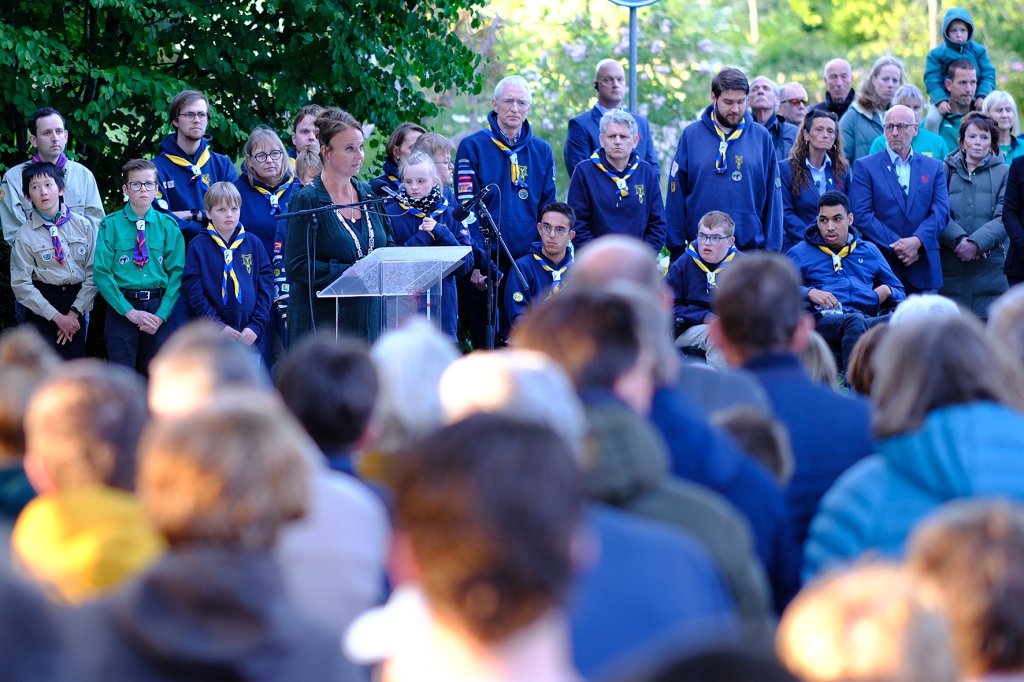
Students read poems they had written themselves. Other guests also laid wreaths. They were assisted by Scouts from Impeesa and the Maurits Group. Veterans formed a guard of honor next to the monument throughout the commemoration. The Laurentius Drum and Bugle Corps provided musical accompaniment.
Read Mayor Stemerdink's speech
Ladies and gentlemen, boys and girls,
Food airdrops over Valkenburg Airport. If you ask older residents about the end of World War II, that’s the first thing they’ll mention. They’ll tell you how, as children, they ran to Wijngaardenlaan to watch the British and American planes flying by in the distance. And they’ll tell you that back home, there was Swedish white bread on the kitchen table—as delicious as cake, whiter than white.
Shortly thereafter, on May 5, 1945, the Netherlands truly began to celebrate. That’s because the German occupiers had surrendered in Wageningen. But fighting was still ongoing in the western part of our country. In Voorschoten, too, we still had to be patient for a few more days. Fortunately, on May 8, the day finally arrived when Voorschoten was also liberated.
Canadian soldiers and the Princess Irene Brigade ride into our village. At the beginning of Bijdorpstraat, there’s even a decorated triumphal arch waiting for them. It’s a celebration everywhere. Overjoyed residents are eating gum and chocolate. A girl catches a cigarette and brings it to her father. A little boy drinks Coca-Cola for the first time in his life. And he thinks it’s really gross.
80 years of freedom
We’re fast-forwarding the clock 80 years. 80 years of freedom. Across the country, we’re reflecting on how World War II ended—and how the Netherlands was liberated thanks to the efforts of brave soldiers and resistance heroes. Every year, we gather here to commemorate the victims who gave their lives for us.
We gather together with people of all ages—veterans, students from the Fortgens School, and Scouts from Impeesa and the Maurits Group, as well as young people and their parents, family members, neighbours , and friends. It’s truly special to me that so many of us come together here in Voorschoten time and time again. Although I also understand why…
Because even today, the consequences of World War II are still felt. The news we hear these days on the radio and TV brings to mind the horrific events of that time. But they are also still felt by families who have lost loved ones.
Today, I’d like to talk to you about a very special group of loved ones: our local resistance heroes.
Your neighbor, a great-aunt, the shopkeeper down the street. All fellow villagers who dared to rise up. Who put all of our lives—our future—above their own.
Alexander Adamski, Bram Limburg, Jan Wagtendonk
On March 12, students from the Fortgens School, together with our veterans, planted a “Resistance Heroes Tree” on Verzetsstrijderspad in the Starrenburg neighborhood: a linden tree, known for its fragrant white-and-yellow flowers. A tree dedicated to all local Resistance heroes, both known and unknown. The students and veterans talked about three resistance heroes from Voorschoten: Alexander Adamski, Bram Limburg, and Jan Wagtendonk.
Alexander was a Polish student who joined the Dutch resistance. Like Bram, he spied for the Packard intelligence service. There, they gathered information about the occupying forces’ activities, which they relayed to British intelligence using secret transmitters.
Bram was also one of the people who, one evening, removed the entire Voorschoten population registry from the “ town hall .” With that courageous act, he saved a large number of his fellow villagers from deportation.
Jan was a medical student. He, too, was an active member of the resistance. On March 12, 1945—just a short time before the end of the war—he, along with Alexander, Bram, and 17 others, was lined up against a wall on Hofplein in Rotterdam and riddled with bullets. This was in retaliation for attacks they had nothing to do with.
The bodies had to remain on the street for 24 hours. Only then were the next of kin allowed to remove them.
Alexander was 25, Bram was 20, and Jan was 23.
Bertus van Aken, Teun de Groot, Frans Kusters
You’re surely familiar with Alexander, Bram, and Jan from the street names. You might also think of Bertus van Aken and Teun de Groot.
Bertus was a well-known painter who owned a paint and wallpaper store. He was also the founder of the resistance group “Rond de Laurentiuskerk.” There, for example, they arranged for shelter, money, and ration coupons for people in hiding.
On September 3, 1944, Bertus was shot four times in the doorway of his home on Voorstraat. The assassins thought their attempt had succeeded, but thanks to the family doctor’s quick intervention, Bertus survived the attack.
When he took over his paint and wallpaper store again after the war, he predicted that people would stop hiring painters and start painting themselves. Nothing beats a professional house painter, of course, but given the lines outside the home improvement stores on Saturday afternoons, he sure was right!
Teun was a bicycle dealer. As a staunch anti-Nazi, he made no secret of his love for his country. The story goes that he once even refused to patch a tire for a member of the Landwacht.
Just like Bertus, Teun was shot in his own home. But he didn't survive. Teun left behind five children.
That same day, the occupiers also showed up at the door of office clerk Frans Kusters. Their intention was to shoot him at home, but because his wife stayed by his side the whole time, they took Frans with them, ostensibly to check his ID at the police station.
In Wassenaar, the kidnappers pretended their car had broken down. Frans was forced to get out of the car and was allegedly shot “while trying to escape.”
The three resistance heroes, Bertus, Teun, and Frans, were victims of the so-called Silbertanne operations. These were secret reprisal operations in which the victims were killed by anonymous assassins—Dutch SS members.
Frans Everstijn, Cor van Osnabrugge, Martinus van der Stoel
I’d also like to mention Frans Everstijn, Cor van Osnabrugge, and Martinus van der Stoel. They, too, are local resistance heroes whom you know from the Starrenburg neighborhood.
Frans was the local leader of the National Support Fund, an organization that provided money and false documents to people in hiding. After he helped a person in hiding obtain a false identity card, he was betrayed. He died in the German concentration camp at Neuengamme.
Cor, a contractor, worked for the National Organization for Assistance to People in Hiding. In that capacity, he maintained contact with other regions regarding hiding places. He survived the war.
General practitioner Martinus also survived the war. He was particularly dedicated to helping Jewish children. In addition, he was active in the doctors’ resistance, a successful underground resistance movement. Israel awarded him the special Yad Vashem honor, a medal given to non-Jews who helped Jews.
Leo van der Bijl
We know all this because much of it has been recorded in writing. Also, because various villagers have collected all those facts and stories for us.
Leo van der Bijl was the one who championed the street names in Starrenburg. He was also very active in the resistance himself. Perhaps you’ve read one of the books he wrote on the subject: *Dorp in oorlog* and *Zand over acht*.
Shortly after Leo’s death in 2000, Mayor Peter Cannegieter also unveiled a plaque in his honor. It became “Leo van der Bijl Park.”
Even more names on the monument
I mentioned a number of our local resistance heroes whose names we know. These are stories of ordinary people, just like you and me. It sends shivers down my spine because I simply cannot imagine how much courage these people must have had to do the right thing. I always ask myself: Would I be that brave? I hope I never have to answer that question.
The stories I’ve shared with you can never be complete. Here on the monument, you’ll see even more names. Please take a moment to read them and discover their stories. Some names may sound familiar to you, while others may not. But all of these residents had the courage to stand up—to risk their own lives to do what was right and help others.
Lewise Judith Polak, Mauritz Heiman van Someren
Before I conclude, there are two more names I’d like to mention. On March 20, we laid the first Stolpersteine in the sidewalk in front of the last home of Lewise Judith Polak and Mauritz Heiman van Someren—two Jewish residents who were both murdered in Auschwitz.
Lewise and Mauritz, fellow villagers we must never forget.
Keep Telling Stories
Keep talking. Keep passing on the stories. Keep mentioning names. If you visit the “80 Years of Freedom” exhibition at the Voorschoten Museum, you’ll see and read those stories and understand why freedom is so special.
Thanks to our veterans and resistance heroes, we regained our freedom in 1945—the freedom to be who you are, to live and work in freedom. It seems so obvious to us, but it isn’t.
You and I just observed two minutes of silence. Two minutes… We all had our own thoughts during those two minutes. Personally, I always think of my grandfather, who returned from the war suffering from severe war trauma. I also reflect on the suffering—which is unimaginable to me—that so many have endured. And for what? Two minutes. A moment that recurs every year. A tradition we must cherish, without letting it become routine. For me, the question is: what are we going to do after these two minutes of silence? What are we going to do with the thoughts we had? What are we going to do with the many stories—including those of our resistance heroes? What lessons have we learned that we will put into practice starting tomorrow?
Let’s continue to remind one another that 80 years ago, we made a promise to ourselves—and to all future generations—that this would never happen again.
Thank you very much.