
National Remembrance Day, May 4, 2024
Mayor Nadine Stemerdink, together with two children from Gevers Deynoot Elementary School, laid a wreath this evening at the monument on Koningin Julianalaan in Voorschoten.

Students read poems they had written themselves. Other guests also laid wreaths. They were assisted by Scouts from the Leif Erikson and Maurits groups. Veterans formed a guard of honor next to the monument throughout the commemoration. The Laurentius Drum and Bugle Corps provided musical accompaniment.
You can read Mayor Stemerdink's speech below.
Speech by Mayor Stemerdink
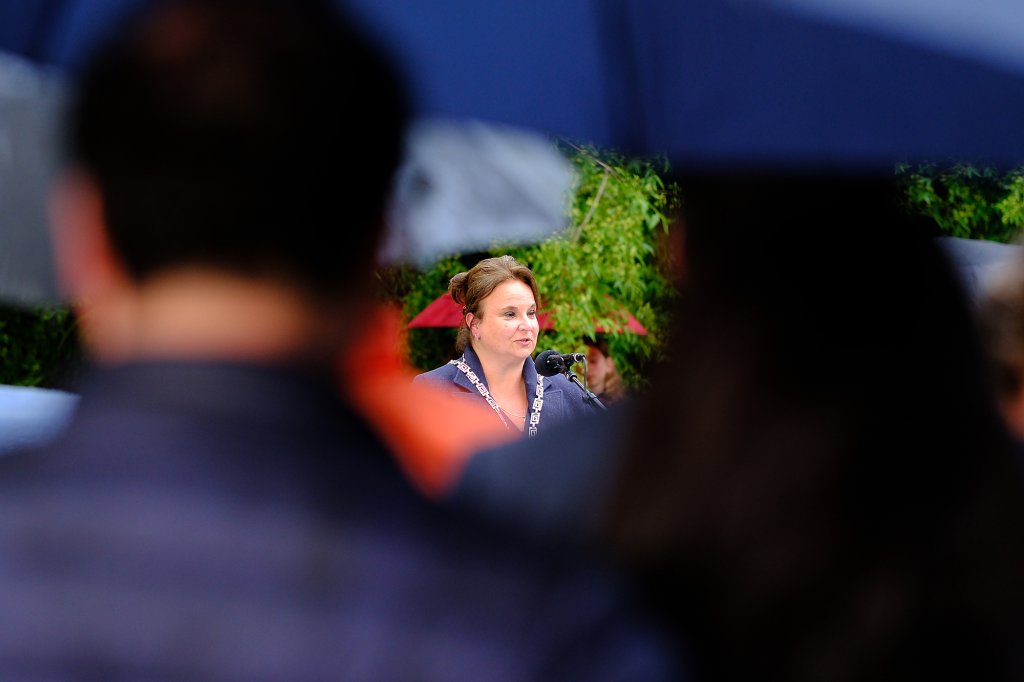
Ladies and gentlemen, boys and girls,
Freedom Speaks: A Prelude to 80 Years of Freedom. That is the theme under which we commemorate this year the men and women to whom we owe the fact that we can gather here today in freedom. We gather to reflect. To be still. But above all, to share memories and tell stories.
We’re gathering here with people of all ages—our veterans, students from Gevers Deynoot Elementary School, scouts from Leif Erikson and the Maurits Group, and many more young people along with their parents, family, neighbours , and friends. As mayor, I’m so proud that so many of us are here together—especially at a time like this.
A prelude to 80 years of freedom. What does that mean? Among other things, it means that the children born back then are now nearly 80 years old. Those children grew up during years of scarcity and reconstruction. This also includes children whose parents lived through the war firsthand. In many cases, they witnessed their parents’ grief—grief over what they had endured, what they saw happening around them, and the loved ones they had lost.
For those children of the past—who are now the elderly—that sorrow is part of everyday life. They commemorated the “ processing ” in their own ways, but they all agreed on one thing: never again war, never again sowing hatred, never again excluding a group of people.
And yet that is exactly what we are seeing happen again today. Anti-Semitism is not an isolated incident, but a centuries-old form of racism that, if we do nothing, will be passed down from generation to generation. Since October 7, the number of antisemitic incidents has increased even further. This is evident not only from statistics but also from my interactions with our Jewish residents. I wonder: have we truly forgotten what we agreed upon together 79 years ago with the utmost conviction? What we promised each other? Never again!
I recently had a conversation with René, a true native of Voorschot who grew up in Rotterdam. Many of you know him from his volunteer work: behind the counter at Heymans IJzerwaren, at the fire museum, as a firefighter for 17 years, as a traffic director for the Avondvierdaagse for 45 years, and much more.
René came up with the idea to install Stolpersteine here in Voorschoten. These yellow-copper “stumbling stones” are memorials through which we commemorate the victims of National Socialism around and during World War II. They are placed in the sidewalk in front of the victims’ last freely chosen homes. Such stones are already in place at more than 1,200 locations throughout Europe. Thanks to René’s thorough research, we will also be able to install the first Stolpersteine in our village next year. René will do this together with his grandson Ruben.
Aside from that wonderful initiative, I was curious to hear where René’s vast knowledge of and interest in our history came from. He then told me his story—an emotional account of the impact the war still has on him—and we both had to take a sip of water every now and then.
May 10, 1940. The first day of the war. René’s father, Hans, is sent as a soldier to the Peel-Raamstelling, a defensive line in North Brabant and Limburg. There is particularly fierce fighting between Mook and Mill, but the enemy’s superiority is too great. Slowly but surely, the Dutch troops are pushed back to Zeeland. On May 27, when Zeeland surrenders, Hans is taken prisoner of war.
When the Dutch soldiers were released in 1940 and Hans returned to Rotterdam, he learned that married men were not being drafted into the labor service—forced labor in Germany. So he quickly decided to marry his girlfriend at the time. But after a while, he was arrested after all and had to go to Germany to work.
He ends up in the caves of Peenemünde. It’s a secret place where forced-laborers are made to manufacture parts for fighter jets and missiles. Naturally, they’re tempted to secretly sabotage the process by deviating by a few tenths of a millimeter here and there. Eventually, a French soldier helps Hans escape from the dreadful caves.
In 1945, when the war was finally over, Hans—scarred by those grueling years—returned to his wife. But it turned out that she had sided with the NSB and the Landwacht during the war. They subsequently divorced.
Fortunately, Hans doesn't stay alone for long. Because on the street where his parents have temporary housing, he meets a nice girl, Jo, who turns out to be René's mother.
She, too, experienced the war firsthand in Rotterdam during its very first days. During the bombing raid of May 14, 1940, Jo had to flee her burning house—wearing slippers and clutching her glasses.
Jo becomes a courier between Gelderland and the west. She transports all sorts of things by bike. For example, by hiding ration coupons inside a loaf of bread, she ensures that people in hiding can also get food.
René was born in 1947. His parents named him that because it was the name of the soldier who had saved Hans from the caves of Peenemünde. Much to the displeasure of one of his grandfathers, since it’s customary to name your son after his grandfather… Grandpa makes that very clear to the little boy—an incredibly sad feeling that still affects René when he thinks back on it.
1947 marked the beginning of the reconstruction effort. There were no homes, food was scarce, and rubble lay everywhere.
At home, they don’t talk much about the war. Every Sunday, the whole family visits Grandma and Grandpa. There, too, there is sadness—for example, because an uncle boarded a ship bound for America just before mobilization, which is considered desertion. Three aunts also live with sadness and anger over the war. That is the environment in which René grows up.
René also has fond memories. For example, how his grandfather, who is a sculptor, set aside a glass box to turn it into a beautiful crib. Or think of the little goat he was given when he was about five years old—even though it was ultimately meant to be eaten, just like the pigeons and rabbits that roamed the community garden.
When René was about thirteen, his father Hans had a good job, and they were even able to go on vacation to Italy. While Hans helped out at the restaurant, René stood behind the bar. Those were good times.
Hans strikes up a conversation with some German tourists. A discussion gives him an important insight: by no means did all Germans support the ideas behind the war. That realization helps him a little more in coming to terms with his immense grief. Hans even ends up making a good German friend as a result. Though he has to swallow hard again when René comes home with his current wife, Gerdy, who’s from Twente and a fan of Schlager music.
This story, filled with suffering but also with moments of joy, is extraordinary. René gave me a glimpse into the impact the war had on his parents’ lives. He also showed me the impact it had on his own life—how he still struggles, still gets emotional when recalling those memories.
There are hundreds, even thousands, of other stories like this. We must continue to pass those stories on as well. Because even though we’ll be celebrating 80 years of freedom next year, we must not forget them.
Fortunately, we are indeed passing these stories on. At the end of March, I had the opportunity to spend an hour teaching a class of eighth graders at Gevers Deynoot Elementary School. The children asked questions and shared the impressive stories they had heard from their grandfathers, grandmothers, and neighbours . I was so impressed by their engagement with the events of the war.
We stand here today in freedom. Let us take a moment to reflect on just how extraordinary that is—knowing that war on the European continent is close at hand. Knowing that divisions in society are becoming ever more pronounced. Talk to one another. Listen to one another. Let’s hold each other to the promise we made 79 years ago. Let’s work together to ensure that we’re still standing here together in peace next year. So that next year, too, we can say to one another: Never again!
Thank you very much.