
Wmo customer journey
A customer journey means that the municipality interviews a number of residents about their experiences during the process of submitting a notification or applying for a product or service. This covers the entire process; from searching for information up to and including the handling by an employee and any subsequent care.
Reason for the research into the Wmo customer journey
In early 2019, the audit committee issued a report advising the municipality – among other things – to improve the information regarding the Wmo. During this improvement process for resident information, the desire arose to map out the customer journey.
How does the municipality map out the customer journey of a Wmo client?
The municipality interviewed approximately ten residents from Voorschoten and Wassenaar. All of them had submitted an application for one or more Wmo provisions. These concerned various types of applications for domestic assistance, transport provisions, Health support, and guidance by an external party. Sometimes it was also a combination of these provisions. During the interview, which usually lasted half an hour, the municipality asked residents about their experiences during the various stages of the application process, such as searching for information, the conversation with the Wmo consultant, and the final decision on the application.
The interviews were conducted in January and February 2020. The interviews formed the basis for a persona, which is a person in whom recurring experiences come together. The information from the interviews was used to create a role-play. In a meeting with the Wmo consultants, administration, team leader, and communications advisor, they experienced what a resident goes through.
Due to the coronavirus, things went differently. The meeting was postponed to early July and was held digitally instead of physically. Usually, it is a very active interactive session where participants pay attention to the phases in the process, emotions, and tips for improvement.
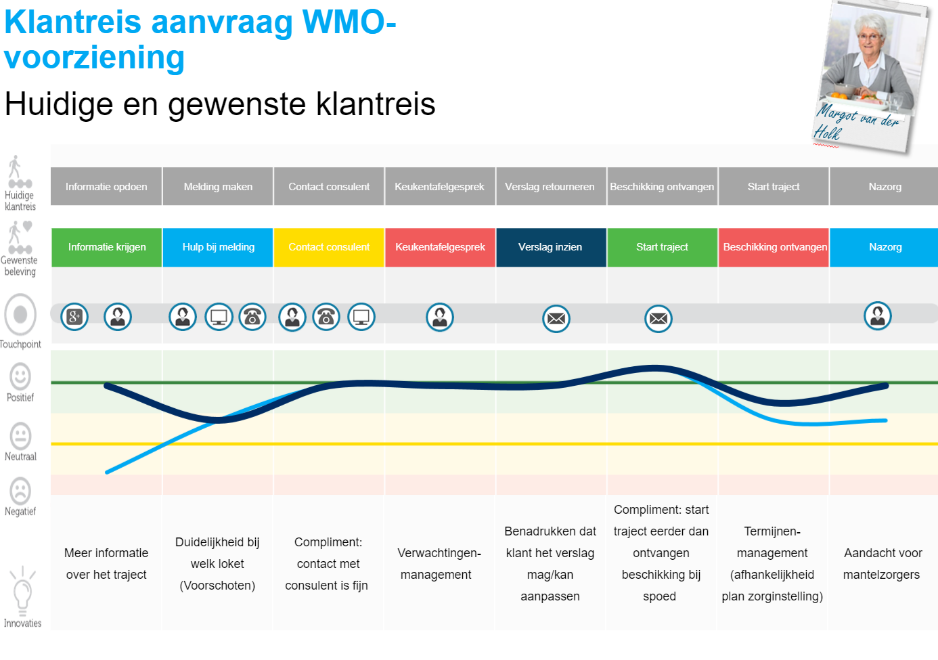
Below you can see the current customer journey (light blue) and the desired customer journey (dark blue).
What does the customer think and what will the municipality do with that?
The main conclusion of this research is that residents are already reasonably satisfied with the process. Of course, waiting is not a good experience and sometimes a kitchen table conversation turned out differently than expected. Especially the beginning and the end of the process can be improved.
The municipality will immediately start adjusting the website to make it clearer that the Wmo is not only for the elderly, but also for young adults, for example. An infographic will also be introduced, an A4 page explaining the various steps in the process through text and visuals.
The municipality will continue to monitor the turnaround times—that is, the time between when a report is filed and the first appointment. If it is not possible to shorten this turnaround time, residents must at least know how long it will take and understand why that is the case. In Wassenaar, the accessibility of the municipal office came up in a number of interviews. The fairly steep wheelchair ramp and the stairs are inaccessible, and most people are unaware that they can use the elevator via the rear entrance. Therefore, the municipality will do a better job of highlighting this option. The experiences of and with informal caregivers were also discussed during the interviews. In addition to the “ Health ” (informal care support), informal caregivers also handle many tasks for their partner, loved one, or neighbour. The “mantelzorgcafé” (informal care café) helps support informal caregivers. Not all informal caregivers are equally aware of this support option yet.
Thank you for your dedication!
The municipality is pleased with the outcomes and the improvements that have been initiated based on the interviews. To all residents who contributed to this: thank you!