
2020 Financial Statements: A Huge Gap Between Municipal Responsibilities and Funding from the Central Government
The municipality ended 2020 with a surplus, even though the budget had anticipated a deficit. The “ executive board ” (Municipal Management Report) states this in the 2020 Annual Financial Statements. The COVID-19 pandemic created a significant amount of additional work while simultaneously preventing many projects from being carried out or causing delays. Nevertheless, the municipality achieved a number of milestones over the past year. Significant results were achieved in the areas of construction, sustainability, and regional cooperation. One of the goals set to be realized this year is the establishment of a new municipal administrative organization.
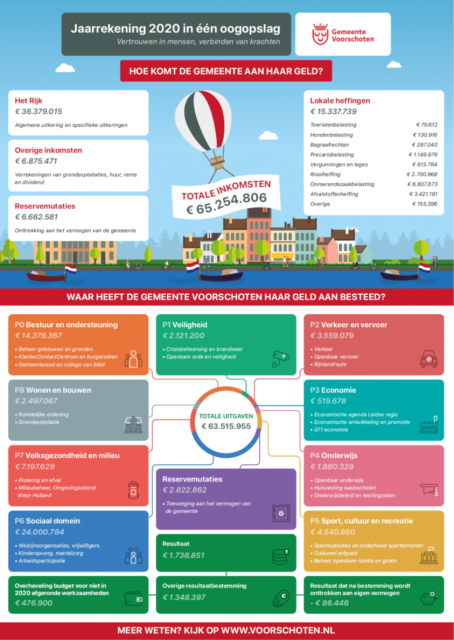
According to the budget, the municipality had anticipated a deficit of €400,000. In the end, there was a surplus of €1,740,000. Alderman Finance Director Marcel Cramwinckel: “The positive balance is largely due to a few one-time windfalls and the fact that we made significant mid-year adjustments to the budget last year because of rising costs for the ‘ youth care.’ The pandemic and the establishment of our own organization also caused delays in spending. Nevertheless, we structurally receive too little funding and policy autonomy from the national government for the tasks we carry out. There is a yawning gap between municipal responsibilities and the funding provided by the national government. This really has to change. This year, I expect we will have to make drastic decisions if the national government does not come through.”
Cost Control and social domain
The municipality faces new financial challenges in 2021 and beyond as a result of structural deficits in the areas of “ youth care ” and social services. Municipal spending on youth care has risen dramatically between 2015 and 2021 and is placing a heavy strain on the budget. Voorschoten is working hard to bring these costs under control. However, municipalities are being assigned an increasing number of responsibilities, such as implementing the Climate Agreement and building additional housing, while the national government provides little or no funding to cover these costs. In addition to the decentralization of the “ youth care ” (a program to support people with limited Dutch language skills), other examples include employment and income support, as well as “ Health ” (special care) for the chronically ill and the elderly. In 2021, municipalities will also assume new responsibilities in the area of integration.
Working on the construction agenda
The “ executive board ” aims to have plans approved for a total of 500 to 600 housing units by the end of this council term, 25% of which will be affordable housing. Over the past year, significant progress has been made on the construction agenda at various locations in Voorschoten. In 2020, the Roosenhorst project was completed, and decisions were made regarding the Segaar/Arsenaal site and Beresteijn. The zoning plan for the Intratuin site has now been finalized, and housing construction there can begin in 2022. Housing for seniors is being built at the Foreschate site. Plans have been developed for approximately 185 homes at Huize Bijdorp. Plans are currently being implemented for 24 homes on Einsteinlaan. Performance agreements have been made with the housing associations for the next four years regarding, among other things, more housing (including for specific target groups) and sustainability measures.
Facilities
After nearly 15 years of discussion, it was decided to develop a multifunctional facility (MFA) for cultural and community activities on the library site.
Voorschoten is becoming increasingly sustainable
Making Voorschoten energy-neutral by 2030 is an ambitious goal, but the most important steps toward this have been taken with the adoption of an environmental policy plan and the launch of the heating transition vision. To meet the obligations of the Climate Agreement, Voorschoten has worked with other municipalities in the region to develop a Regional Energy Strategy. All new projects must be approached in a sustainable manner. Agreements to this effect have been made with the housing authorities. Private homeowners, business owners, and residents of buildings in various neighborhoods in Voorschoten have received customized advice on energy conservation and the generation of renewable energy.
Cooperation in the Region
When it comes to regional cooperation with other municipalities, Voorschoten has focused even more on the Leiden region—the municipalities of Leiden, Leiderdorp, Oegstgeest, and Zoeterwoude—and on Holland Rijnland. The guiding principle is that more intensive cooperation must yield results for the region and/or individual municipalities. Together with Holland Rijnland, future plans have been developed for housing construction, landscape conservation, mobility, and the regional energy strategy. A study has been initiated to determine whether the implementation of social policy can be better addressed in collaboration with the municipalities in the Leiden region rather than through the current partnership with Leidschendam-Voorburg and Wassenaar and the joint procurement efforts in the Hague region.
New Organization Close to Residents
In 2020, work began on phasing out the Duivenvoorde administrative structure and establishing Voorschoten’s own civil service organization. This will be an organization that is close to its residents and fully dedicated to addressing Voorschoten’s own challenges. The new organization is expected to launch shortly after the summer. A key principle for the new organization is that the best results are achieved when residents, businesses, and institutions are involved in planning at the right time. The participation policy that has been adopted establishes the framework for this.