
Information about Japanese knotweed
The climate is changing and nature is changing with it. You can also experience the consequences of this in the municipality of Voorschoten, partly due to the spread of harmful plants such as the Giant Hogweed and the Japanese Knotweed. For example, the Japanese Knotweed is a stubborn plant that can cause significant damage to your garden, your home EN the public space. Read how you can recognize the Japanese Knotweed and what you can do yourself to combat the plant.
Japanese Knotweed in public spaces
The municipality keeps track of the plants' locations on a web Map . Have you spotted Japanese knotweed in a public area? If so, please report it using the reporting form at . Be sure to clearly indicate the location and specify that it is Japanese knotweed. You can also attach a photo to your report. Alternatively, you can contact the Customer Service Department at centre by calling 14071.
The municipality mows the plants monthly during the growing season. This exhausts the plant and prevents further spread.
Overview Map
On the website Map , you can see where Japanese knotweed has been spotted in Voorschoten so far.
Japanese Knotweed on private property
Do you have Japanese Knotweed on your own property? Then you can hire a landscaper or combat the plant yourself. A landscaper can advise you on this. The municipality will not visit the site. You can read extensive advice and assessment of control methods in the Report of the Probos Foundation.
What you need to know about the Japanese Knotweed
- The Japanese Knotweed is an invasive exotic species. An invasive exotic species is a plant, animal, or other organism that is not native to the Netherlands, but has nevertheless established itself here, partly due to the changing climate.
- The Japanese Knotweed dies back above ground in the winter, but blooms above ground from March/April until November.
- The roots run deep (sometimes as deep as three metre). The stems are green with red spots and hollow on the inside. The stems resemble bamboo.
- Japanese knotweed grows at an astonishing rate. First, you see small red buds and leaves, and shortly thereafter, the stems shoot up out of the ground. In the summer, the leaves turn a fresh green and grow as large as your hand. White flowers appear at the tips of the stems. The plant can grow up to two metre tall.
- The Japanese Knotweed is beautiful, but dangerous. It crowds out other plants and, due to its enormous growth vigor, causes damage to cycle paths, asphalt roads, and the foundations of buildings and homes. A small crack or hole is enough for the plant to penetrate your home.
- Early removal is therefore of the utmost importance. For your own garden and home, but also for public greenery and the outdoor space.
What you can do yourself to combat the plant
- Excavation
It is important to remove all roots. A new plant can grow from even the smallest piece of Japanese Knotweed. - Mowing and continuing to mow
Is excavation insufficient because the roots are already too deep? Then pull out the stems and then mow as close to the ground as possible. Repeat this every two to four weeks for several months. Keep going, especially keep mowing. Mowing exhausts the plant and increases the likelihood that it will eventually disappear. - Mowing waste = residual waste
It is important that you remove the mowing waste (not only the roots and released plant remains, but also the soil in which the Japanese Knotweed was growing) and dispose of it as residual waste. Therefore, do not put it in the vegetable, fruit, and garden waste (GFT) bin, but in the container for residual waste. This is due to the risk of the plant spreading further via the GFT.
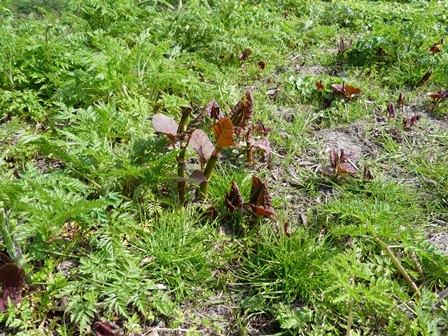
This photo shows the emerging buds of a Japanese Knotweed.
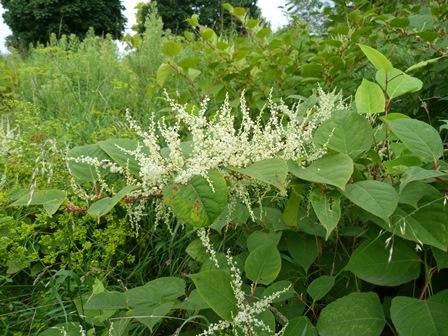
This photo shows the Japanese Knotweed in bloom. Both photos are from the Probos Foundation.